

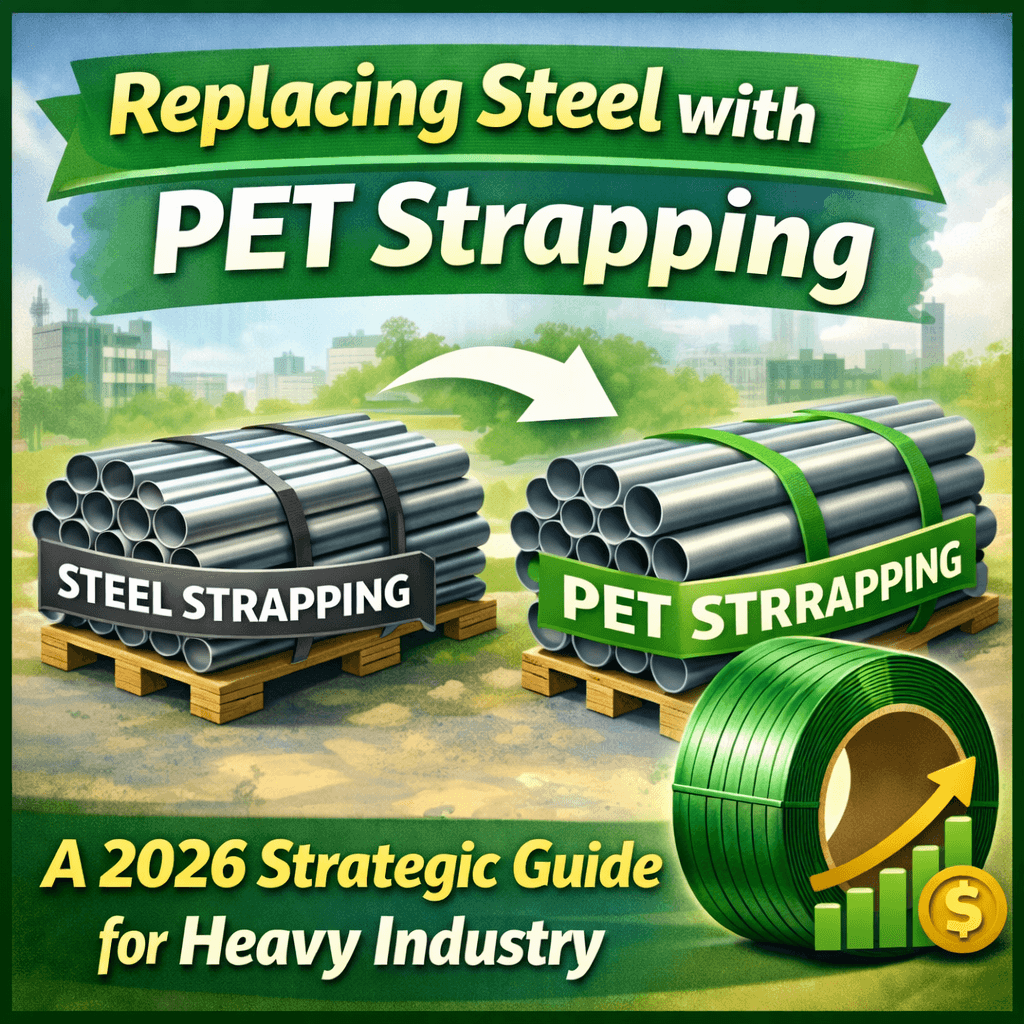
Replacing Steel with PET Strapping: A 2026 Strategic Guide for Heavy Industry
As we enter 2026, the industrial landscape has reached a tipping point. For decades, steel strapping was the unquestioned titan of heavy-duty bundling. However, the convergence of rising steel tariffs, carbon-neutrality mandates, and a breakthrough in polymer engineering has accelerated a mass migration toward High-Tensile Polyester (PET) strapping.
While steel was once the only choice for rigid loads, modern PET now rivals its performance while offering 20% to 60% operational cost savings.
The 2026 Shift: Why Heavy Industry is Cutting the Cord on Steel
As we enter 2026, the industrial landscape has reached a tipping point. For decades, steel strapping was the unquestioned titan of heavy-duty bundling. However, the convergence of rising steel tariffs, carbon-neutrality mandates, and a breakthrough in polymer engineering has accelerated a mass migration toward High-Tensile Polyester (PET) strapping.
While steel was once the only choice for rigid loads, modern PET now rivals its performance while offering 20% to 60% operational cost savings.
Key Technical Advantages
1. High Break Strength & Yield Performance
The primary myth—that plastic cannot hold heavy loads—has been debunked by the latest 2026 production standards. Modern PET straps, particularly the 19mm x 1.27mm "Ultra" variants, now achieve break strengths exceeding 10,000N to 13,000N (approx. 1,350kg).
For the majority of applications in lumber, brick manufacturing, and medium-gauge metal processing, this meets or exceeds the safety requirements previously reserved for steel. Furthermore, a single coil of PET typically provides 40-60% more linear feet than a comparable steel coil, significantly reducing machine downtime for changeovers.
2. Elastic Memory: The "Dynamic Hug"
Steel is fundamentally inelastic. If a load settles, shrinks, or shifts during transit (common with timber or stacked masonry), steel straps become loose, creating a "lethal projectile" risk.
PET offers an elongation recovery of 10–12%. Unlike steel, which stays stretched once stressed, PET possesses "elastic memory." It acts like a high-tension rubber band, continuously "hugging" the load as it shifts. This maintains constant load stability during long-haul vibration and sea freight.
3. Superior Shock Absorption
In the world of logistics, "brittle failure" is the enemy. Steel's rigidity is its weakness under impact; a sudden jolt can snap a steel band that has no "give."
Polyester strapping has a shock-absorbing capacity up to five times greater than steel. This allows it to absorb the energy of a forklift's sudden stop or a crane's jerky movement without reaching the breaking point, preserving both the load and the safety of the operators.
4. Eliminating Corrosion and Product Damage
Unlike steel, PET is 100% rust-proof and chemically inert. This is critical for:
- Outdoor Storage: PET is UV-stabilized and unaffected by rain or snow
- International Sea Freight: Salt-air environments degrade metal bands, leading to structural failure and unsightly rust stains on finished goods (like white lumber or decorative stone)
- Surface Protection: PET is non-abrasive. It eliminates the need for expensive edge protectors required to keep steel from cutting into the product
ROI Analysis: The Financial Imperative
Switching to PET is no longer just a safety initiative; it is a primary lever for margin protection in 2026.
| Feature | Steel Strapping | High-Tensile PET | |---------|----------------|------------------| | Material Cost | High (Subject to Steel Tariffs) | Low (Stable, Recycled Content) | | Freight Weight | Heavy (Adds to fuel/shipping) | 80% Lighter (Lightweighting) | | Safety Gear | Specialized (Steel cutters, heavy gloves) | Standard PPE | | Tool Maintenance | High (Metal-on-metal wear) | Low (Simpler battery tools) | | Recycling | Difficult/Hazardous | 100% Recyclable (Circular Economy) |
The Bottom Line
By moving to high-tensile polyester, companies are reducing freight weight, eliminating the "hidden costs" of workplace injuries (recoil and sharp edges), and meeting 2026 ESG (Environmental, Social, and Governance) targets by using 100% recyclable, often post-consumer, materials.
Conclusion
For heavy industry, the 2026 strategy is clear: unless the load is "extra-heavy" (exceeding 5,000 lbs with sharp edges), PET is the superior choice. It offers a safer work environment, better load security through elasticity, and a massive reduction in the total cost of ownership.
Related pages
From this article: Product catalogue
Product catalogue · Services · Company profile · About us · Contact & quotes · All articles