

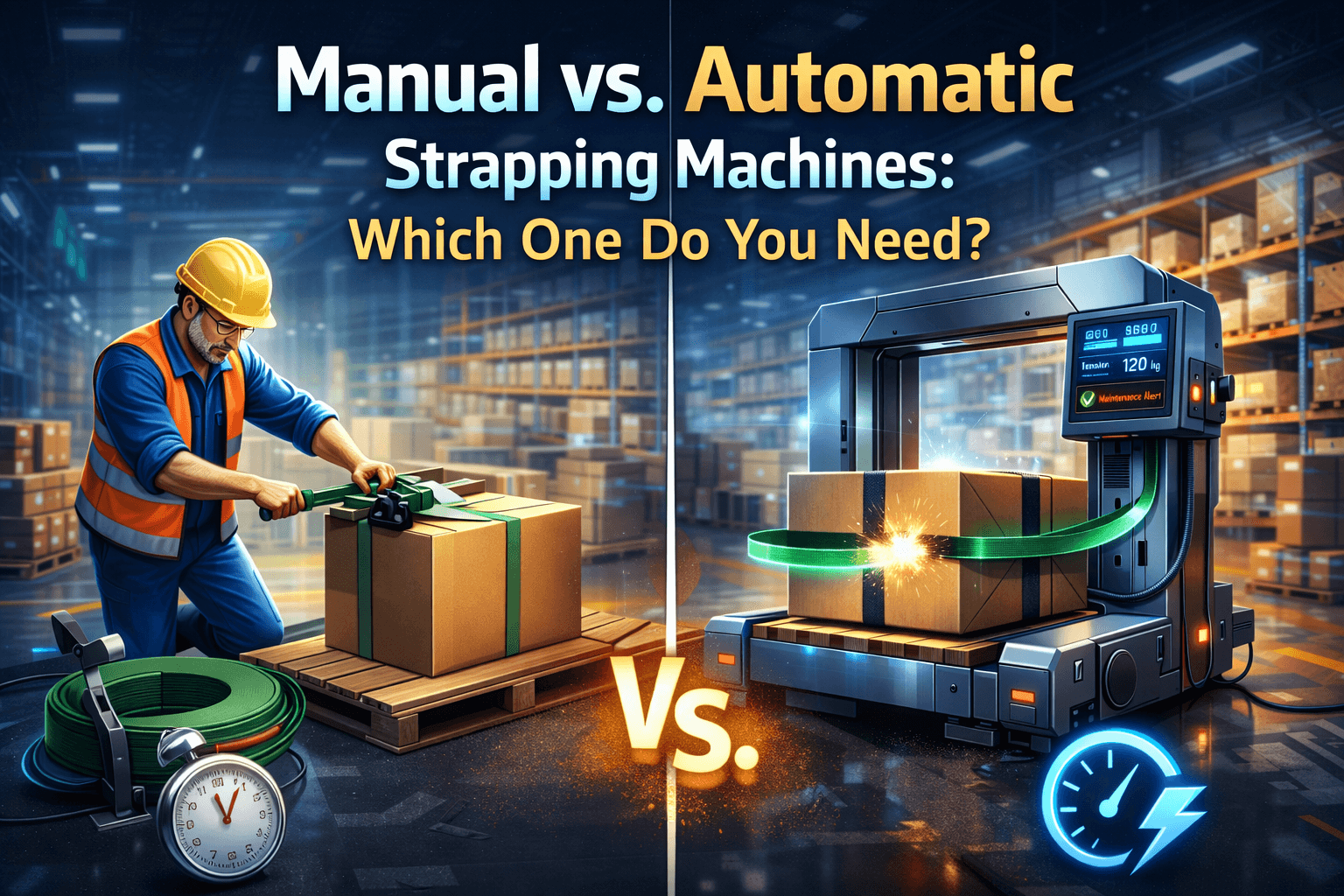
Manual vs. Automatic Strapping Machines: Which One Do You Need?
Efficiency in the packaging department often boils down to a single question: How much of your process should be automated? In the world of strapping, the jump from a manual tool to a fully automatic system is massive—not just in terms of cost, but in terms of throughput and labor requirements.
This guide will help you navigate the three primary categories of strapping equipment to find the perfect fit for your facility.
1. Overview of Machine Categories
Before diving into the "which," let's define the "what." Strapping equipment is generally categorized by the level of human intervention required:
Manual
Handheld tools where the operator performs every step.
Semi-Automatic
A tabletop unit where the operator feeds the strap, but the machine tensions and seals it.
Automatic/Fully Automatic
Arch-style machines that require little to no operator contact with the strap.
2. When Manual Strapping Makes Sense
Manual tools (tensioners, crimpers, and battery-powered combo tools) are the backbone of many small operations.
It makes sense for you if:
Low Volume
You are strapping fewer than 10-15 items per hour.
Mobile Requirements
You need to move around a large yard or warehouse to strap oversized loads that can't be brought to a machine.
Irregular Shapes
You are strapping "non-cuboidal" items like pipes, logs, or machinery parts.
Budget Constraints
You need a solution under $500–$1,500.
3. The "Sweet Spot": Semi-Automatic Machines
Semi-automatic machines are often the first step toward automation for growing businesses. These are typically tabletop units.
Key Benefits:
Operator Ease
The operator doesn't have to manually pull tension, which reduces physical fatigue.
Versatility
These machines don't have an "arch," meaning they can handle packages of almost any height or width, provided they fit on the table.
Affordability
They offer a significant speed boost over manual tools at a fraction of the cost of fully automatic systems.
4. High-Volume Needs and Automatic Systems
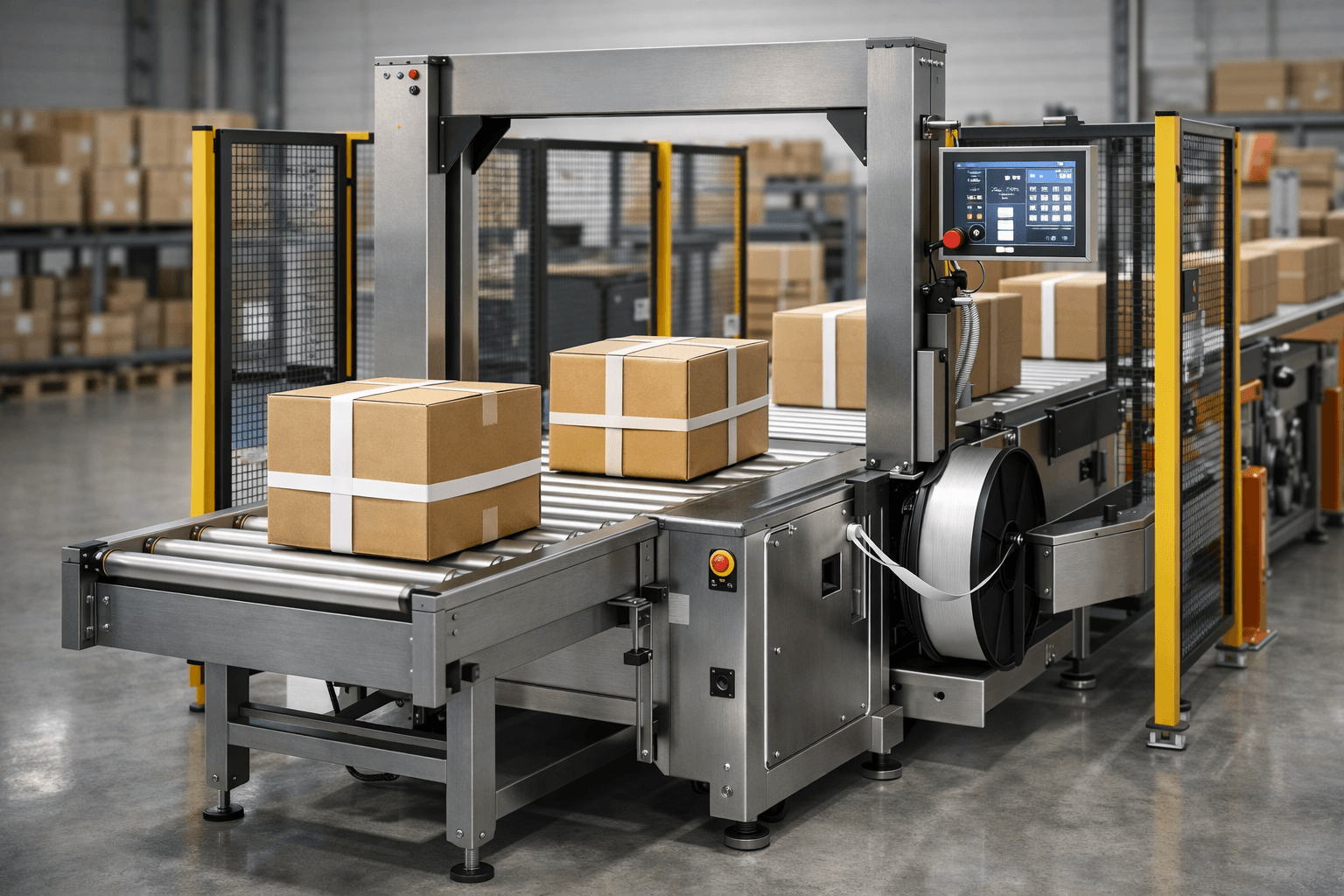
Automatic machines feature an arch (or "frame") that the package passes through. The strap is pre-fed around the arch, and with the press of a button or foot pedal, the machine completes the cycle.
When to upgrade to Automatic:
High Throughput
You are processing hundreds of packages per shift.
Consistency
You need perfectly uniform strap placement on every box.
Integration
Fully automatic systems can be integrated into existing conveyor lines, requiring zero human intervention.
5. Cost vs. Productivity Comparison
| Feature | Manual Tools | Semi-Automatic | Automatic | |---------|--------------|----------------|-----------| | Initial Cost | Low ($) | Medium ($$) | High ($$$) | | Labor Cost | High (Per unit) | Medium | Low | | Cycle Speed | 45-60 seconds | 10-15 seconds | 2-5 seconds | | Portability | Excellent | Limited (On wheels) | Stationary |
6. The Decision Checklist
Still unsure? Ask yourself these four questions:
What is my daily volume?
- Under 50 units (Manual)
- 50-200 (Semi-Auto)
- 200+ (Automatic)
Is my package size consistent?
If every box is a different size, a semi-automatic machine or manual tool offers the most flexibility.
Where is the strapping happening?
If it's on a loading dock, you need portability (Manual). If it's on a production line, you need a station (Automatic).
What is my labor availability?
If you are struggling with a labor shortage, the higher upfront cost of an automatic machine will pay for itself in reduced man-hours.
Conclusion
The right strapping machine is the one that removes the bottleneck in your specific workflow. While it's tempting to want the fastest machine available, a small business may find that a reliable semi-automatic tabletop unit provides the best return on investment without the complexity of a high-speed arch system.
Related pages
From this article: Semi-automatic strapping machine · Fully automatic strapping machine
Product catalogue · Services · Company profile · About us · Contact & quotes · All articles